
GNSS Software Receiver
A GNSS software receiver is an implementation that has been designed and built following the philosophy of software-defined radio. This is done using a reconfigurable computational platform such as a microprocessor, digital signal processing element, graphics processor, or field-programmable gate array. This is in contrast with a traditional GNSS receiver implementation, which leverages a hardwired application-specific integrated circuit (ASIC). The software receiver provides maximum flexibility and the ability to redesign the architecture quickly and efficiently, allowing candidate signal-processing algorithms to be designed and assessed.
The software receiver is coupled with the radio front end and antenna. Various options have been used in this area of research—everything from custom discrete component implementations to commercial-off-the-shelf (COTS) devices such as the Ettus USRP family of devices.
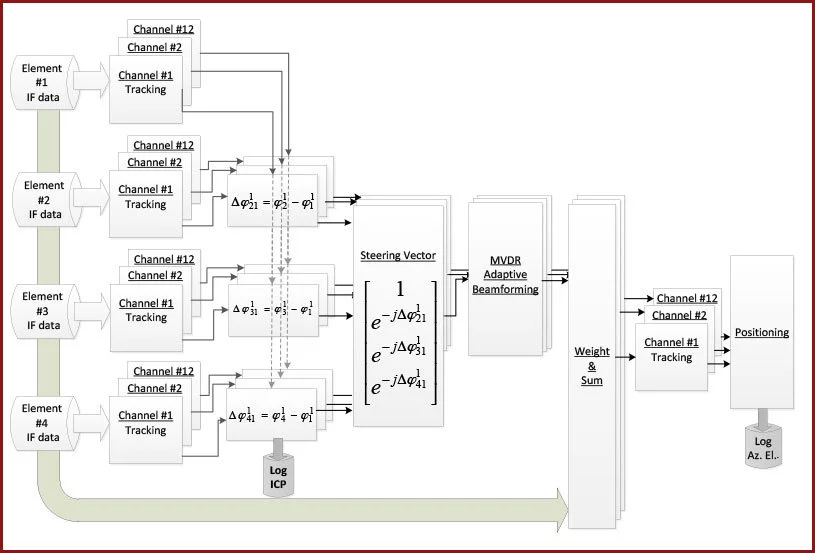
Block diagram of the software architecture for the CRPA implementation
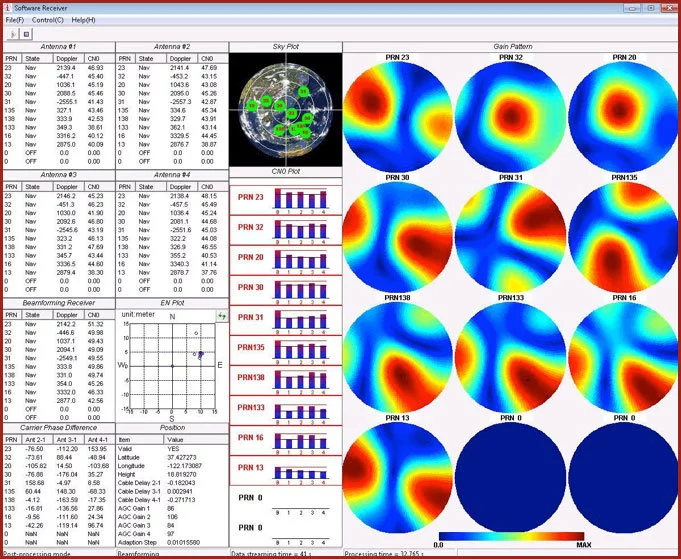
Stanford research in this area has enabled the testing and evaluation of new signals, specialized algorithms, tracking techniques, and so on. Specific research areas include:
- Other GNSS signals plus GPS L2C, L5
- Controlled-Reception-Pattern Antenna (CRPA) arrays
- INS integration
- Loran indoor tracking, frequency & timing
For More Information
- View the Software Receiver Wikipedia article