
Geosecurity
Geosecurity is the idea of using geographical and time-dependent information such as position as a factor in authentication. In essence, where you are is an element in verifying who you are or the authorization of access. One use is for white-listing or black-listing access based on location. Basically, certain applications or data are allowed or disallowed based on location. For example, hospital records can be accessed on a given computer when inside the hospital but not accessible in public locations. A broader use is in geo-fencing, where virtual barriers are created based on position, navigation and time (PNT) dependent information.
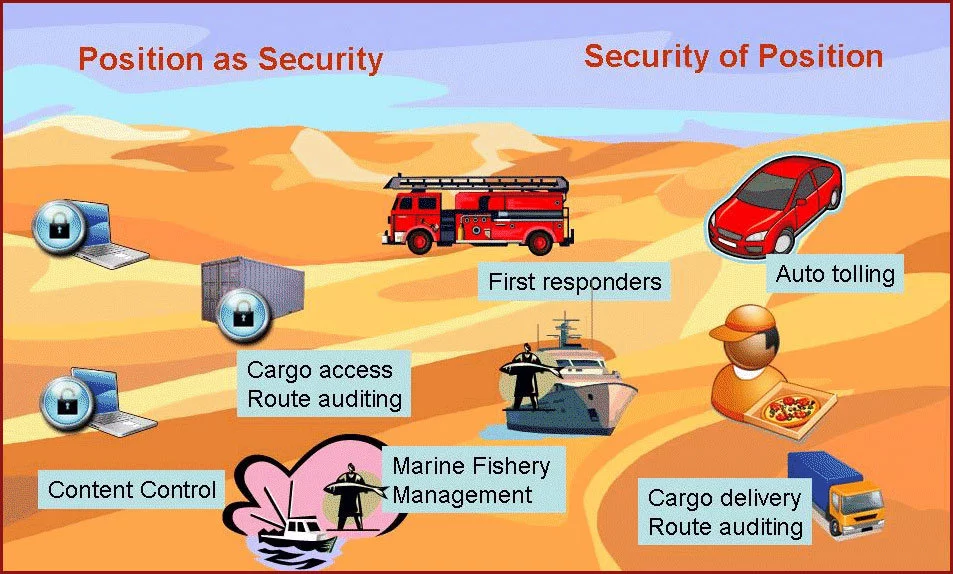
Stanford University GPS Laboratory is conducting fundamental and basic research into geosecurity. Two major related areas of work naturally arise. First is the design and use of navigation signals for geosecurity. Second is developing public means of enhancing the security and authentication of navigation signals.
For assessment of the first area, we have used Loran as our case study system. Loran offers numerous location-dependent features allowing for the possibility of creating stronger authentication. Additionally, Loran is low frequency and high power, which enhances its utility and robustness. This feature makes it difficult to spoof or jam and allows for its use in some indoor environments.
Developing security enhancement design, algorithms and systems is the logical outcome of the use of location information for high-value and security applications. In this work, we develop and look at fundamental techniques for authenticating the source of the signal and the position output.
For More Information
- View a general presentation on Motivation and Means to Achieve Geosecurity